
Pike County Release Date Meaning
MDOC uses the exact label Tentative Release Date. It is a current sentence computation, not a certificate that the person left custody on that day. The date may help with planning, but it must be read with the location, unit, sentence length, sentence date, county of conviction, and location-change date. A person can move to parole or Earned Release Supervision while legal control continues. Another person may remain in a secure facility because of a detainer or processing step.
Pike County Detention Center holds local pretrial and short-term cases. A pretrial detainee does not have an MDOC sentence calculation. Bond, dismissal, a court order, case disposition, and other holds can affect departure. For a local sentence that never enters MDOC, the sheriff's release calculation and the sentencing order are the proper records. The state tentative field should not be applied to that county case.
Scheduled versus actual: A tentative date is a forecast under the current calculation. The actual release record documents the event that took place.
Find Pike County Release Dates
Begin by identifying the custodian. The sheriff handles a Pike County jail booking, and its official site is the durable local source even though it has no public inmate search. MDOC handles a state sentence, including placements at the Pike County Community Work Center and Pike County Technical Violation Center. A court holds the judgment and any later order, while Community Corrections can verify a supervision placement. Mixing these systems is the main source of false conclusions.
- Ask which facility currently holds the person and whether the case is pretrial, county-sentenced, or under MDOC.
- For MDOC custody, open the official inmate search and search by name or MDOC number.
- Verify identity with several fields, then record Location, Unit, sentence data, and Tentative Release Date exactly as shown.
- For Pike County jail custody, call (601) 783-2324 and request the sentencing order, jail-credit calculation, and release entry as applicable.
- Check the court docket for bond, sentence changes, revocation, or another order that may alter the expected date.
- Confirm the final event through the jail release record, MDOC discharge certificate, or verified parole or ERS placement.
The broader Pike County released-inmate search helps when the person has already disappeared from one system. A missing result alone proves nothing. The person may have transferred, the name may differ, or the public search may not preserve a past record.
Note: Save the retrieval date with every tentative result because MDOC can update the calculation after new sentence or credit information arrives.
Read MDOC Release Date Fields
The MDOC detail layout puts the date in context. Search results can include MDOC ID, demographics, entry date, present location and unit, location-change date, sentence count and total length, offense, county of conviction, sentence date, photograph, and Tentative Release Date. The fields describe a state-corrections record. They do not recreate a short Pike County jail stay unless the person later entered the state system.
| Field | How to read it |
|---|---|
| MDOC ID | Stable identifier used to avoid a name-only match |
| Location and unit | Current displayed state placement, including institutional or community status |
| Location-change date | Date the displayed placement changed, not always a release date |
| Sentence fields | Conviction and term data used in the state record |
| Tentative Release Date | Anticipated date under the present calculation, not proof of actual departure |
The official MDOC detail example shows the tentative-date label and its nearby sentence fields.
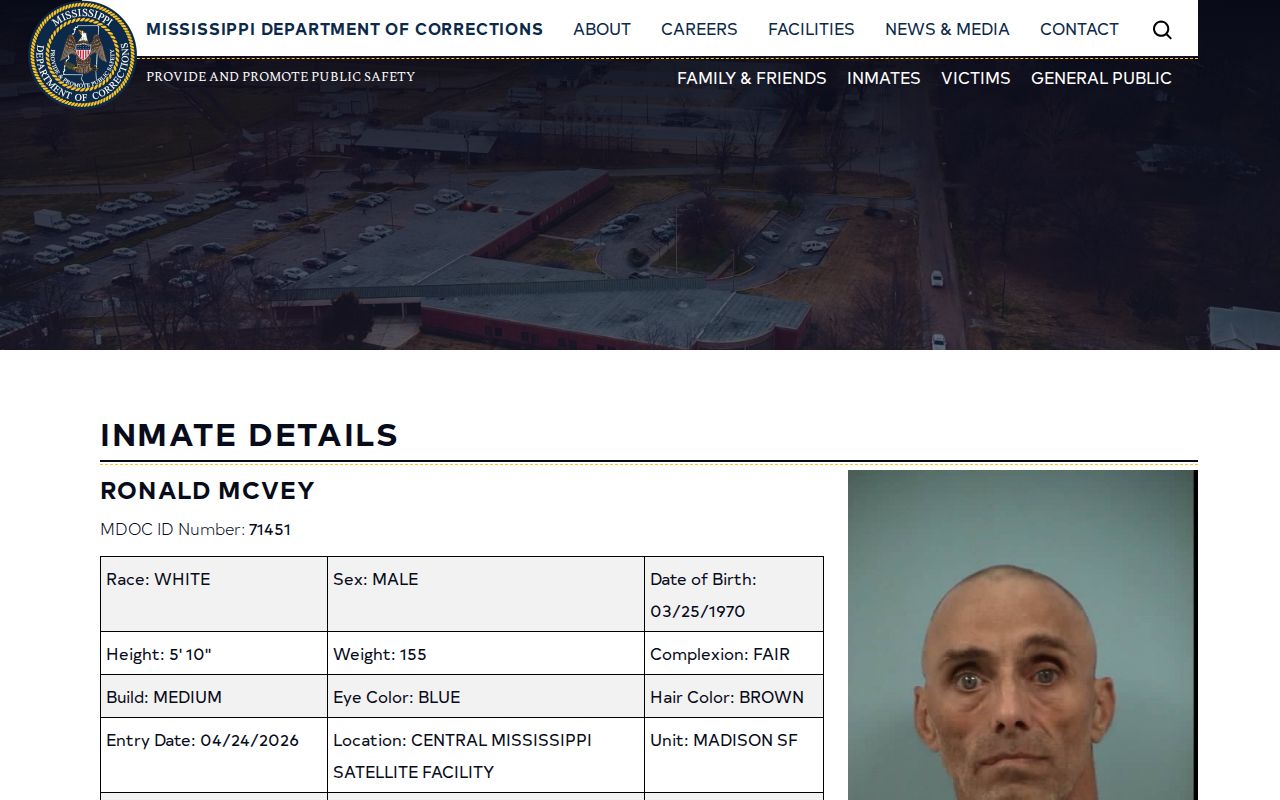
The screenshot is a field example, not a Pike County release certificate. The identity, offense, county, dates, and MDOC number must be checked together.
Pike County Sentence Credit
The MDOC Inmate Handbook explains that qualifying pre-sentence or pretrial county-jail time can be reflected on the state time sheet. Eligible time is deducted from the earliest sentence date to establish the sentence-begin date. The credit must relate to the cause number for which the person is incarcerated and fall between the offense and the earliest current sentence date. MDOC requests jail time from the county of conviction, and a credit stated in the sentencing order is posted unless it duplicates time already counted.
This gives Pike County records a direct role in a later state calculation. A missing or corrected jail-credit entry can move the tentative date. The useful source set is the sentencing order, the Pike jail custody dates, and the MDOC time sheet. When the records conflict, ask the responsible records unit to reconcile the dates instead of doing arithmetic from a docket summary.
County credit is not the same as earned time. Jail credit accounts for qualifying time already spent in custody. Earned time is a statutory reduction tied to eligibility, conduct, and performance during the sentence. Both can affect a state computation, but they arise from different facts and rules.
Mississippi Earned-Time Calculation
Mississippi Code Section 47-5-138 authorizes earned time based on good conduct and performance. For eligible sentences imposed after June 30, 1995, the statute provides 4.5 days of earned time for each 30 days served when MDOC finds compliance. The ordinary allowance may not exceed 15 percent of the sentence, subject to a statutory exception for certain people under age 21 who committed a nonviolent offense. The familiar “85 percent” phrase is only shorthand for this cap. It is not a universal Pike County release formula.
Eligibility matters. Section 47-5-139 excludes several categories, including many life, habitual-offender, and sex-crime sentences. It also addresses forfeiture and escape. Section 47-5-138 permits earned-time loss after serious rule violations. Consecutive sentences are treated on their total term for commutation. Because sentence type and offense history control the result, a simple percentage applied to a court sentence can be wrong.
Earned release does not equal full discharge. The statute places a person released before sentence expiration on ERS until expiration, retains inmate status, and keeps the person under MDOC jurisdiction. If ERS is revoked, the person can return to custody for the remainder under the statute's rules.
Note: Apply the 15-percent cap only after confirming statutory eligibility and the exact MDOC sentence structure.
Why Pike Release Dates Change
A tentative date is recalculated from the record MDOC has at that time. Sentence amendments, credit corrections, conduct, parole action, ERS review, and custody holds can change the path. Administrative work may also separate a calculated date from the day of physical release. MDOC says parole and ERS dates are not guaranteed, and the case manager handles exact arrangements.
| Factor | Possible effect | Best confirmation |
|---|---|---|
| County jail credit | Moves the sentence-begin computation when qualifying time is added or corrected | Sentencing order, Pike custody dates, MDOC time sheet |
| Earned-time accrual | Can reduce an eligible sentence within statutory limits | MDOC calculation and Sections 47-5-138 and 47-5-139 |
| Discipline or forfeiture | Can remove earned time and move the date later | MDOC institutional and time records |
| Sentence amendment | Changes the legal term or structure used in computation | Signed court order and updated MDOC record |
| Detainer or hold | May prevent community departure or cause transfer | Holding and receiving agencies |
| Parole or ERS action | May create conditional community placement, but is not guaranteed | Parole Board, MDOC Records, Community Corrections |
MDOC's official release guidance says processing may take 30 to 45 days and that a discharge certificate is required before release. That span is a published processing statement, not a new date to add to every Pike County result. Use it as a warning that arrangements and final approval take time.
Pike County Jail Date Calculations
A Pike County jail sentence that never enters MDOC must be kept separate from the state framework. No Pike-specific written good-time formula, weekend-release rule, daily release time, or public calculation policy was found. Applying the MDOC 15-percent cap to a local case would invent a rule the source does not establish. The valid path is computation-specific: obtain the court's sentence, confirm all credited jail days, ask the sheriff for its release calculation, and later request the actual release entry.
Pretrial custody requires a different check. A bond order may authorize release, yet another case, probation warrant, out-of-county warrant, state hold, or federal detainer can prevent departure. Ask whether all holds cleared and whether Pike released the person to the community or handed the person to another custodian. The Pike County court-information route can locate the order that establishes legal authority. The jail timestamp documents implementation.
This distinction is Pike County's key computation issue. The county has a jail plus two local MDOC facilities. A person can stay near Magnolia while moving from a county record to a state sentence calculation. Name the exact facility, cause number, and agency in every request.
County calculation rule: Do not apply an MDOC earned-time percentage to a Pike County jail sentence without an official record showing that framework governs the case.
Confirm Pike County Release Dates
Final proof depends on what happened. For release from the Pike County Detention Center, seek the booking and release entry with the actual date, time, disposition, and destination. For an MDOC sentence, ask for the discharge certificate or releasable discharge record, actual discharge date, release authority, and supervision status. If the result indicates parole or ERS, confirm the placement through the Pike Probation & Parole Office.
VINELink can supply a timely agency-fed release change. Registration helps when the person remains in custody and a later event matters. The VINELink Check details the Mississippi search and alert path. Treat the notice as a status update from the reporting agency, then verify the exact legal event with the jail, MDOC, or court.
Preserve the source, retrieval date, and exact field label. Keep “Tentative” attached to the online date. A dated screenshot can show what the public portal displayed, while a custodian record is stronger when formal proof is needed. If the displayed date and later record differ, use the actual release or discharge record for the event and retain the earlier result as a snapshot of the old computation.
A transfer record needs one more step. Departure from the Pike County Detention Center to MDOC, another jail, the U.S. Marshals Service, or ICE is not a community release. Follow the destination and confirm the next admission before looking for a projected date in that system. If MDOC shows a Pike CWC or Pike Technical Violation Center location, use the full facility name because both state sites share a Magnolia address and telephone. A precise agency trail prevents a county timestamp from being mistaken for final discharge.